Beautifully styled shelves aren’t about filling every empty space with decorative objects. The shelves that look the most effortless usually have something more deliberate happening: visual weight is balanced, objects are layered, and the arrangement has enough breathing room to let each piece stand out.
Whether you’re styling built-in bookshelves, floating shelves, or open shelving, the goal is to create a display that feels collected rather than simply decorated. Think of books, artwork, ceramics, greenery, and personal objects as parts of one composition rather than separate things that need somewhere to go.
The easiest way to achieve that look is to build the arrangement in stages. Start with what you already own, establish the larger shapes first, then add depth, variation, and personality as the composition comes together
Clear Your Shelves and Edit Your Collection
Before you start styling, take everything off the shelves. Working with a completely empty surface makes it much easier to see the proportions you’re working with and prevents you from automatically putting everything back in the same place.
As you remove each piece, group similar items together; books, artwork, ceramics, baskets, plants, and decorative objects. Then edit the collection. Keep the pieces you genuinely like or that have meaning to you, and set aside anything that feels dated, repetitive, or simply doesn’t work with the direction you want to take the shelves.
Your books deserve a little attention too. If brightly coloured dust jackets make the display feel visually noisy, consider removing some of them to reveal the simpler hardcover beneath. You don’t need to do this to every book; selectively editing the colours can create a quieter, more cohesive backdrop while still allowing the shelves to feel personal.
The goal isn’t to create a perfectly coordinated display. It’s to start with a collection that gives you room to create one.

spaces
Happy
days ♡
Build Around Larger Anchor Pieces
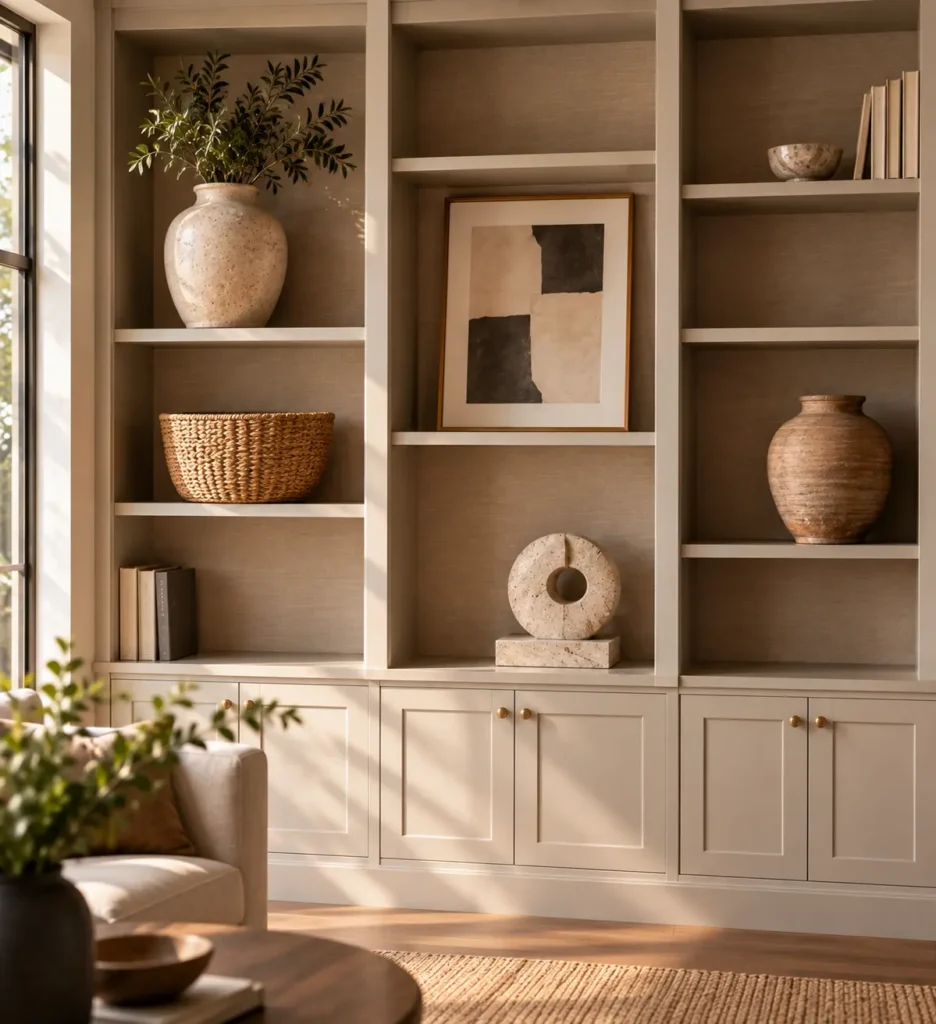
Once the shelves are empty and you’ve edited your collection, resist the temptation to start with the smallest decorative objects. Begin with the pieces that have the greatest visual weight.
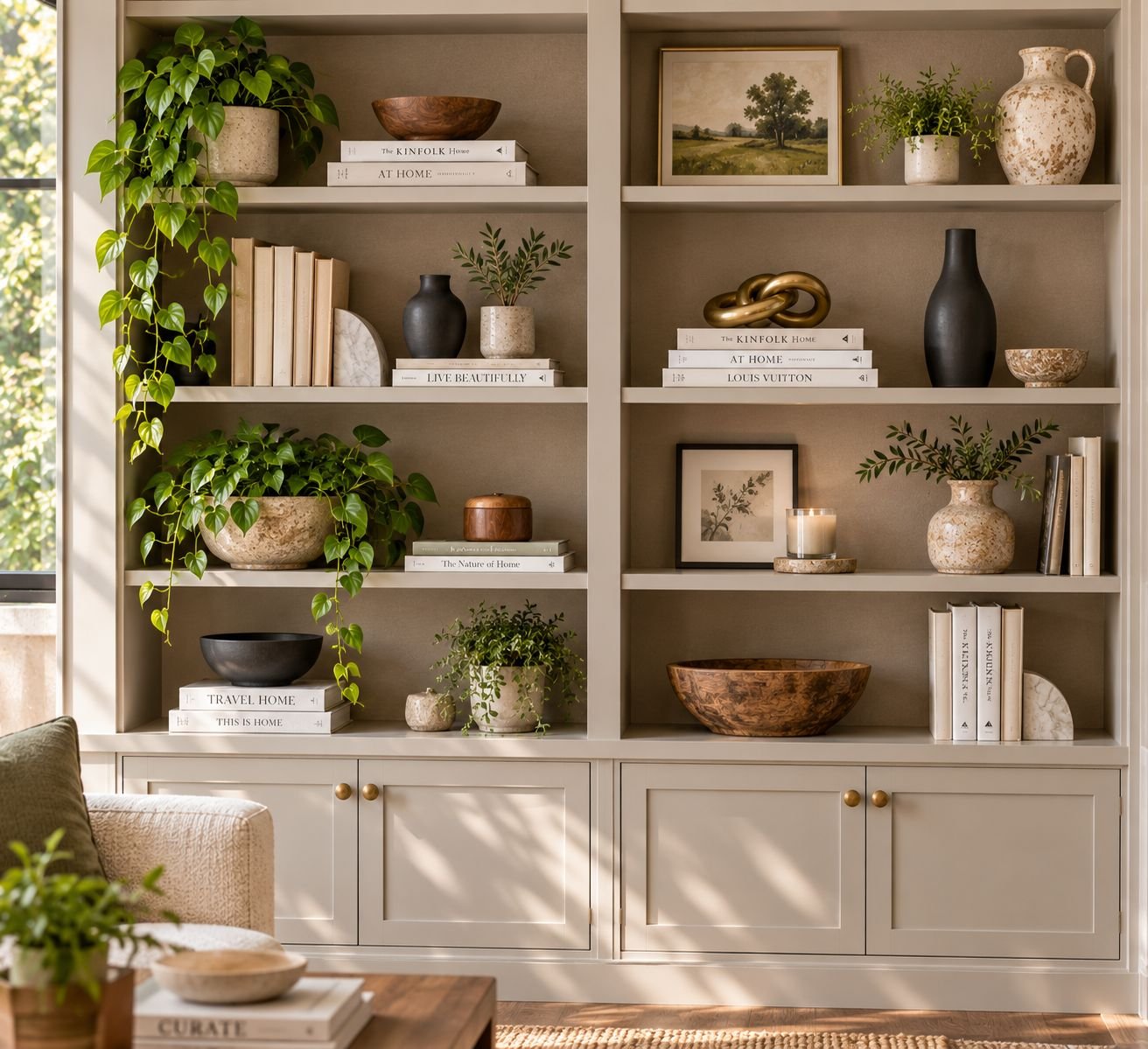
A large ceramic vase, oversized artwork, substantial basket, or sculptural object can establish the composition for everything that follows. Place these pieces across different shelves rather than grouping all the largest objects together. This creates a natural rhythm and gives you clear areas to build around.
Think of these pieces as the anchors of the display. Once they’re positioned, the smaller books, ceramics, and personal objects become much easier to place because you’re filling in a composition rather than trying to make dozens of individual decisions at once.
Don’t worry about making every shelf symmetrical. A more relaxed arrangement usually feels more collected and sophisticated when the larger forms are balanced throughout the bookcase.
Start With the Visual Foundations
- Oversized ceramic vase: gives a shelf a strong vertical shape and works beautifully as a visual anchor.
- Framed abstract artwork: adds scale while introducing another layer of colour and pattern.
- Large woven basket: brings substantial visual weight while adding a softer, natural texture.
- Travertine or stone sculpture: provides a grounded, architectural element that contrasts with softer objects.
Build in Layers, Not Rows
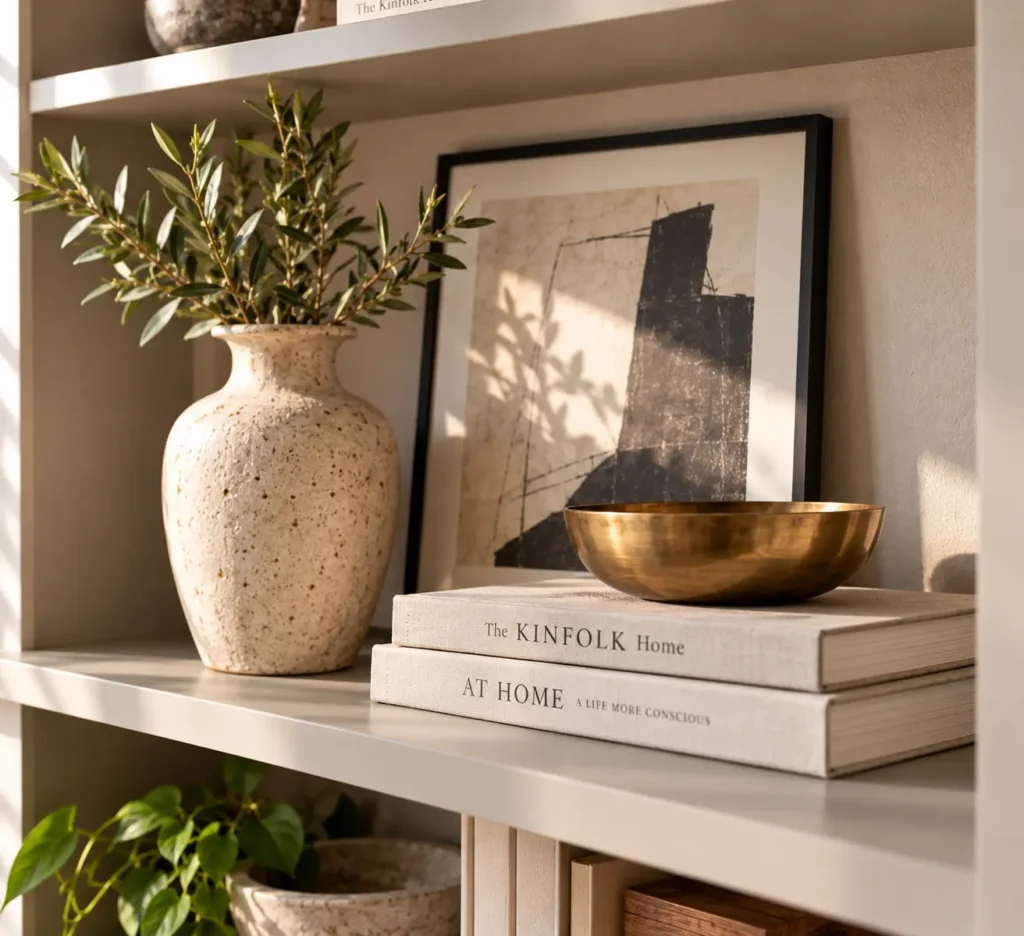
Once your larger anchor pieces are in place, start creating depth. One of the easiest ways to make shelves look professionally styled is to stop treating them as a single flat line.
Lean a framed print behind a vase, place a smaller object in front of a stack of books, or let two pieces overlap slightly rather than positioning everything side by side. These small changes create foreground and background, giving the arrangement more dimension and making it feel collected rather than carefully lined up.
You don’t need to layer every object. A few intentional overlaps throughout the shelves are enough to create that sense of depth.
Create More Depth
- Coffee table books: create a substantial horizontal base for smaller objects while adding colour and visual interest.
- Framed art prints: lean them behind vases or sculptures to introduce another layer without taking up additional shelf depth.
- Small ceramic sculptures: work well in front of books or artwork where their shape can remain visible without becoming isolated.
Distribute Visual Weight in a Zig-Zag Pattern
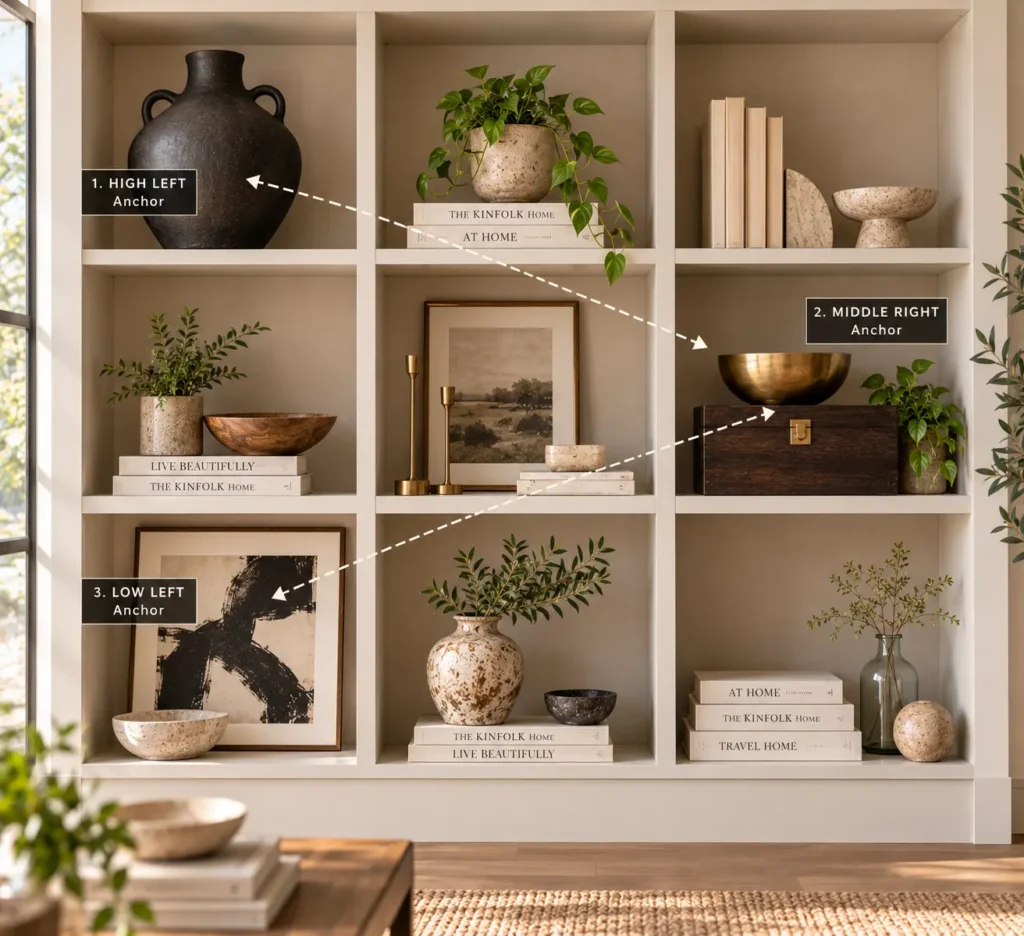
Once you’ve established layers, look at the shelves as one composition rather than styling each shelf independently.
If all your largest, darkest, or visually heaviest pieces sit on the left side, the entire bookcase can feel heavier in that direction. Instead, distribute those stronger elements across different shelves so the eye naturally moves through the display.
A simple way to do this is to imagine a loose zig-zag through the bookcase. A substantial dark vase might sit toward the upper left, another visually weighty element toward the middle right, and another lower down on the opposite side. The objects don’t need to match, they simply need to create enough visual balance across the whole arrangement.
The same principle works with books, artwork, baskets, and sculptures. You’re balancing visual weight, not creating perfect symmetry.
Objects That Can Add Visual Weight
- Marble bookends: substantial stone adds weight without requiring a large decorative object.
- Dark ceramic vessels: useful for balancing lighter areas elsewhere on the shelves.
- Textured stoneware bowls: create grounded visual weight on lower shelves.
- Oversized hardcover books: provide a broad horizontal mass that can balance taller objects.
BRING MORE GOOD IDEAS HOME
A little inspiration, delivered regularly.
Get thoughtful decorating ideas, practical home tips, and fresh inspiration in your inbox.
Weekly Inspiration. No Spam
Master the Visual Rule of Odd Numbers
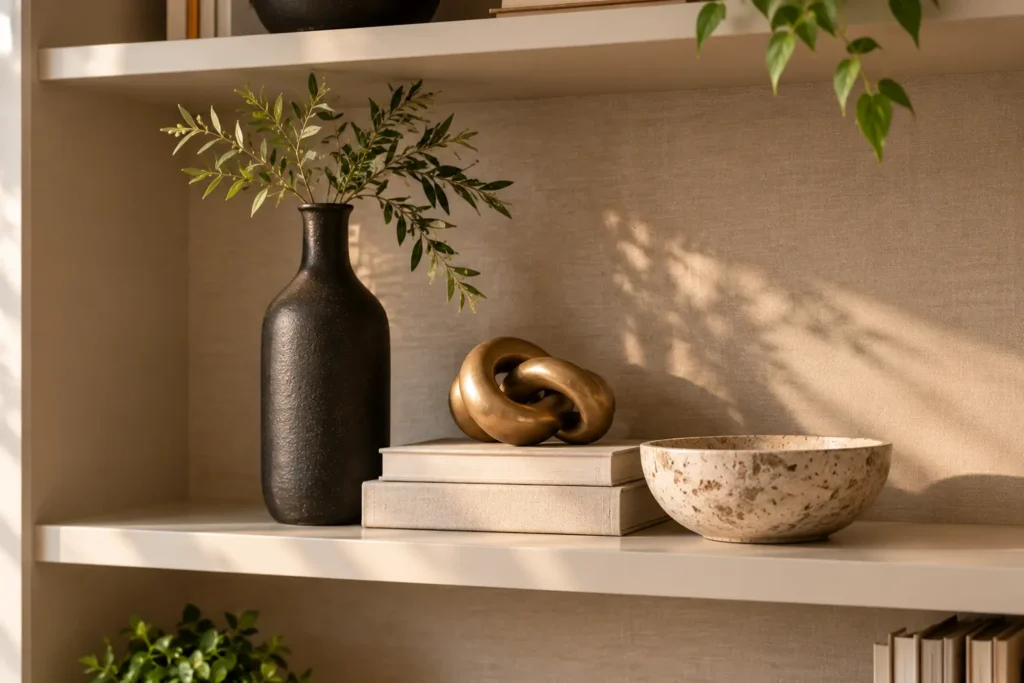
When you’re unsure how many objects to place together, odd-numbered groupings are an easy starting point. Groups of three often feel more natural and visually interesting than arranging everything in pairs.
The trick is not simply to place three objects beside one another. Give the group different heights and visual roles. A tall vase, a medium-sized object, and a low bowl create a loose triangle that gives the eye somewhere to move.
You can use groups of one, three, or five depending on the size of the shelf and the objects you’re working with. And you don’t need every arrangement to follow the rule. Think of it as a useful starting point rather than a formula you have to obey.
Build a Simple Three-Piece Group
- Ribbed ceramic vase: provides the taller vertical element.
- Travertine decorative bowl: adds a lower, grounded shape.
- Brass candle holder: introduces a smaller reflective element between the two.
Use Books to Vary Your Heights and Shapes
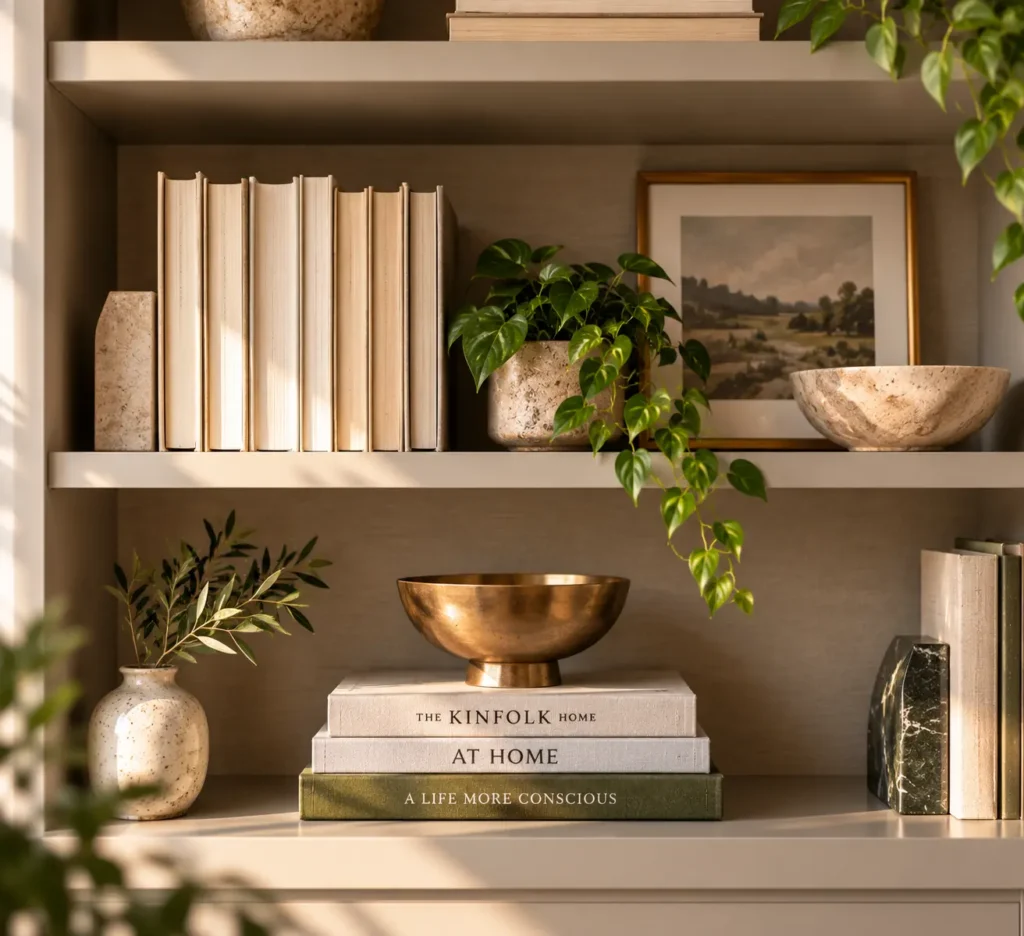
Books are one of the most useful styling tools on a shelf because they can change the height, direction, and visual weight of almost anything placed around them. Instead of lining every book up vertically from one end of the shelf to the other, mix vertical rows with horizontal stacks.
Stand some books upright to create height and structure, then place a small stack of two or three books horizontally on another shelf. A horizontal stack can act like a miniature pedestal for a vase, sculpture, or other small object, while the vertical rows break up the display and draw the eye upward.
You can also use books to create subtle colour repetition throughout the shelves. Choose a few covers that complement the rest of your palette rather than trying to make every book coordinate perfectly.
The goal isn’t to make your books look decorative at the expense of being usable. It’s simply to let something you already own become part of the composition.
Use Books as Styling Tools
- Hardcover coffee table books: create substantial horizontal stacks and add visual weight.
- Travertine bookends: give vertical book groupings a clean, architectural finish.
- Marble book stand: elevates a favourite book or creates another visual level within the arrangement.
- Framed art print: can be layered behind books to create depth and break up long rows.
Mix Textures and Add One Organic Element
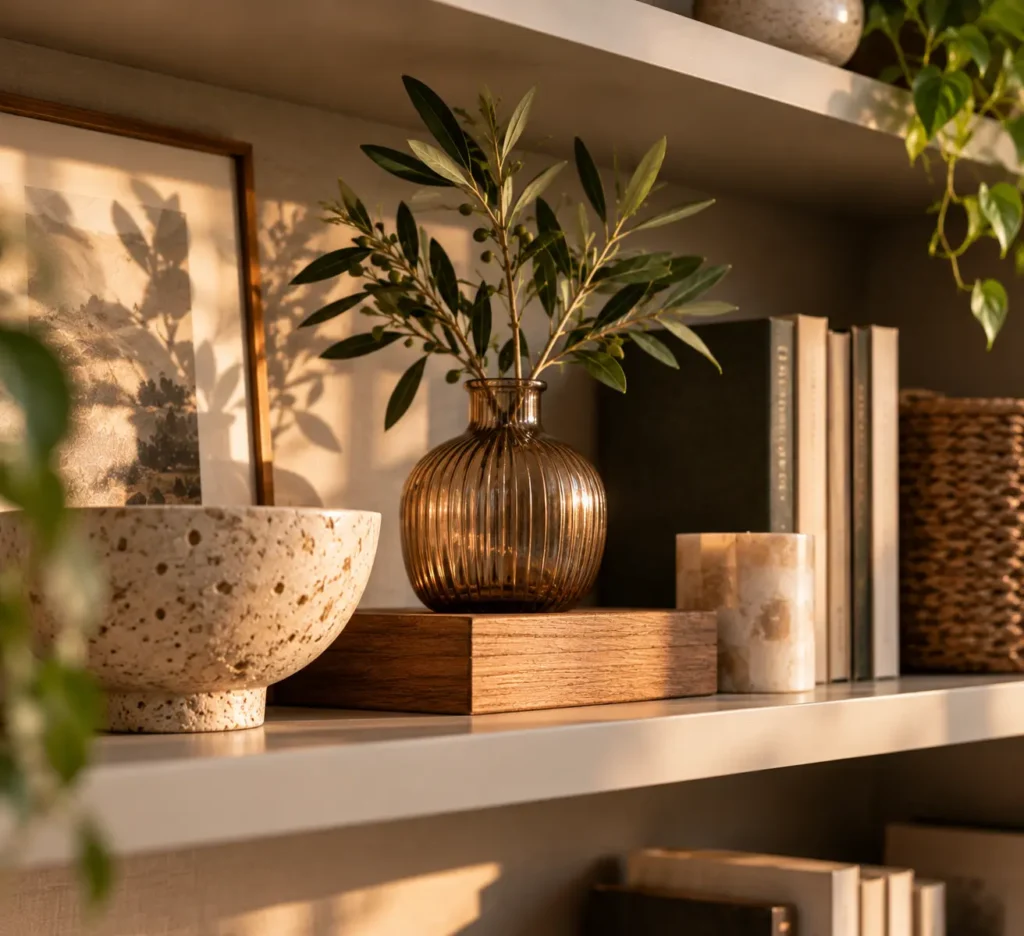
Once the main composition is established, look at the materials you’re using. If every object is ceramic, the shelves can begin to feel repetitive even when the shapes are different.
Mix harder materials such as stone and ceramic with warmer elements like wood and woven fibers. Glass and metal can introduce a little reflection, while books bring softer visual texture through their paper and fabric covers.
Then add one organic element to soften the arrangement. A small plant, a few olive stems, or fresh branches can bring movement and life to an otherwise static display. You don’t need greenery on every shelf; one thoughtfully placed natural element can be enough.
Layer Different Materials
- Fluted glass vase: introduces transparency and subtle reflection.
- Woven seagrass basket: adds natural texture and softens harder materials.
- Alabaster or stone candle holder: brings weight and a tactile, architectural quality.
- Faux olive stems: add an organic element without requiring another large decorative object.
Balance Your Colors with Generous Breathing Room
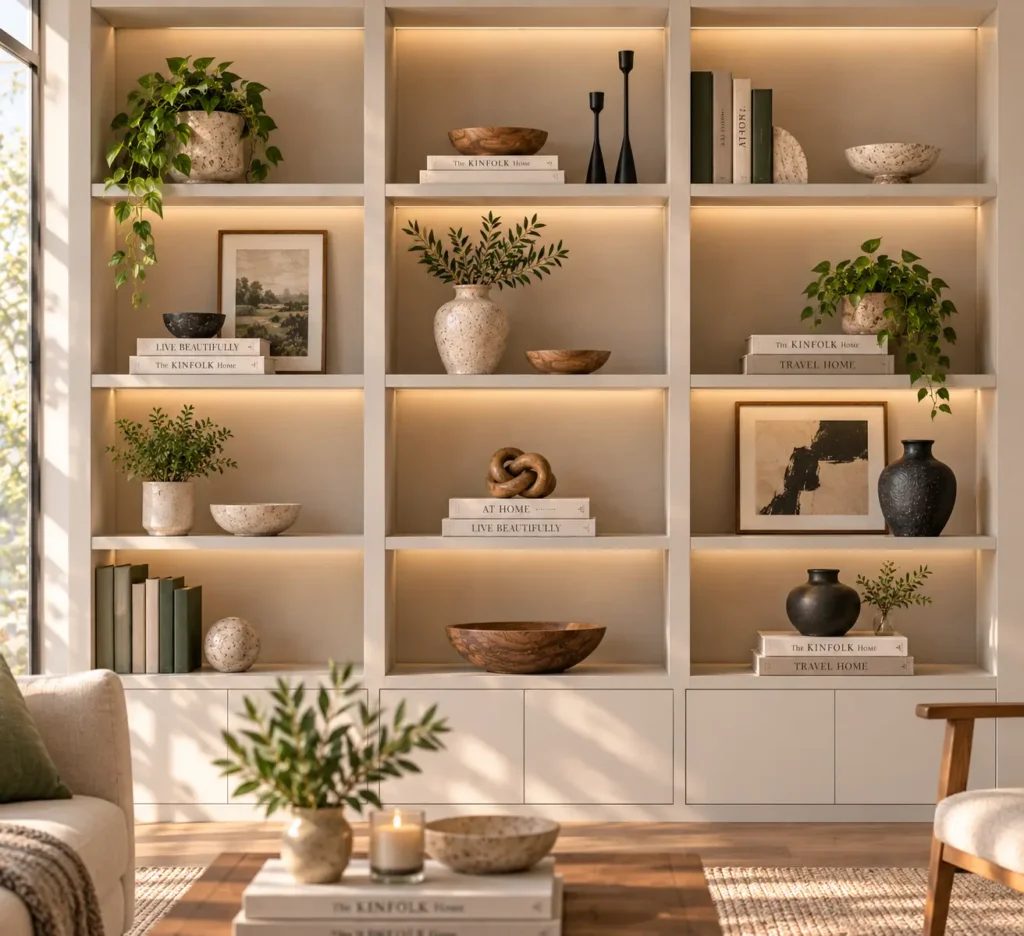
Colour is one of the easiest ways to make multiple shelves feel connected. You don’t need every object to match, but repeating a few tones throughout the display creates a subtle rhythm that makes the arrangement feel intentional.
For example, a muted green from a small plant can appear again in a book cover or artwork farther down the shelves. Warm wood can repeat alongside beige ceramics, while touches of black or brass can quietly connect objects that are otherwise completely different.
At the same time, resist the temptation to fill every gap simply because you have something that could go there. Empty space gives the colours and objects around it room to stand out.
If a shelf feels busy, try removing one piece before adding another. Often the missing ingredient isn’t more decoration, it’s a little breathing room.
Step Back, Reassess, and Fine-Tune
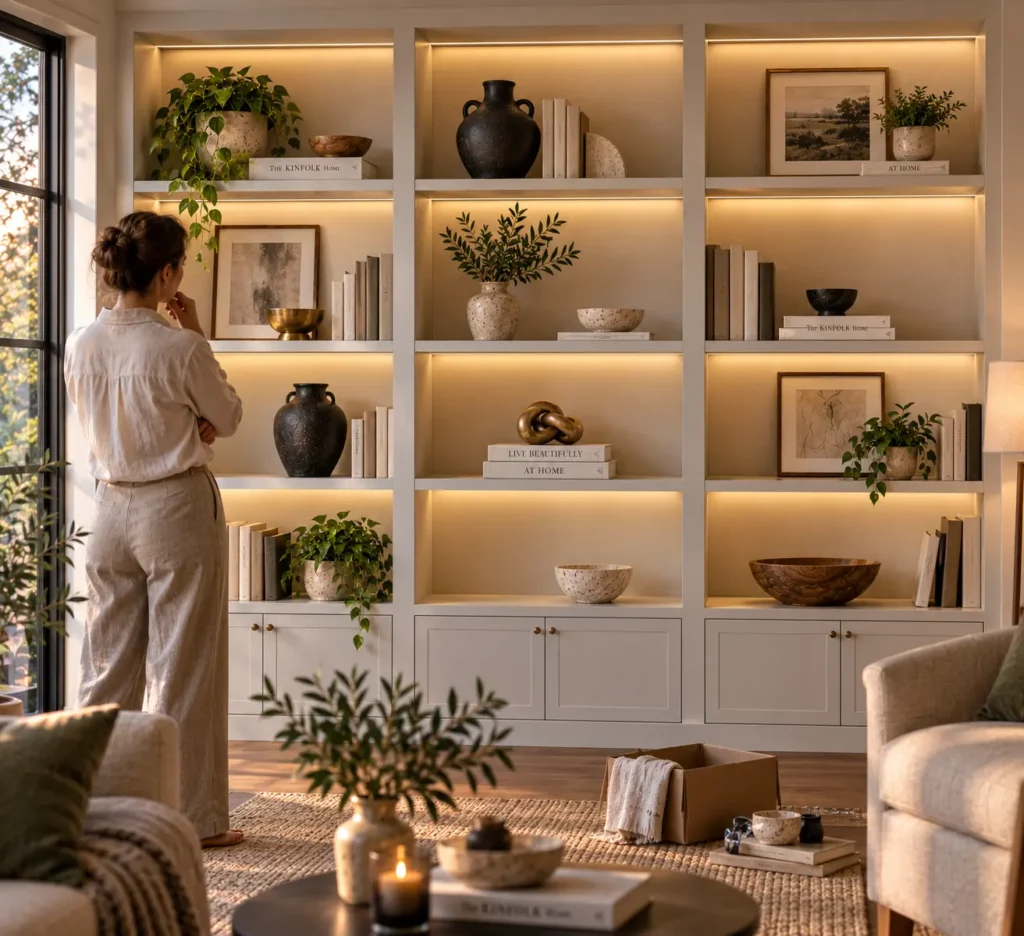
Once everything is on the shelves, don’t assume you’re finished. Step back and look at the entire arrangement from across the room rather than judging each shelf individually.
This wider view makes imbalances much easier to spot. Perhaps one side feels noticeably heavier, several objects are competing for attention, or too many pieces have the same height and shape. You may also notice that one shelf simply needs less on it.
Make small adjustments rather than starting over. Move a heavy object to another shelf, turn an artwork slightly, separate two similar pieces, or remove one object that’s making the arrangement feel crowded. If your shelves have integrated or nearby lighting, check them again in the evening as well; warm illumination can change how colours, glass, metal, and darker objects read.
There isn’t one permanent arrangement that every shelf needs to follow. The final step is simply learning to look at the composition as a whole and adjusting until it feels balanced to you.
Conclusion
Styling shelves like a designer isn’t about following a rigid formula or buying a collection of objects that were designed to match. It’s about understanding how those objects relate to one another.
Start with the pieces you genuinely love. Give the larger forms room to anchor the composition, create depth through layering, distribute visual weight across the shelves, and use books, varied materials, and organic elements to add character. Then step back and edit until the arrangement feels balanced rather than crowded.
And remember that a shelf doesn’t have to stay exactly the same forever. Move things around as your collection changes, bring home a new piece from a trip, or swap an object when you simply want the room to feel different.
The best styled shelves don’t just display what you own. They tell a little story about who you are, what you love, and the things you’ve collected along the way.
RELATED ARTICLES